

How To Clean A Tetra Fish Tank
To ensure your fish stay healthy, it's vital to ensure yous keep the atmospheric condition of your tank optimal.
This requires routine maintenance and cleaning to help maintain the delicate ecosystem in your tank.
Water in your aquarium can hands get harmful to your fish if it is non maintained correctly.
Past maintaining and cleaning your tank correctly, you won't always demand to remove all of the h2o at once. In fact, by doing this, you kill all of the skillful bacteria that take built up.
Advertisements
If you lot are a complete beginner, you lot may think that it's easier to clean a minor tank or bowl; this is an incorrect assumption. The larger the aquarium the easier it is to proceed the water stable, you can read more about why that is, here.
To understand Why You lot Need to Clean Your Fish Tank, The Importance of Regular Cleaning, How Often Should You lot Clean Your Tank, Acceptable Aquarium Parameters, and How to Make clean a Fish Tank in Five Easy Steps and then go along reading.
Why You Demand to Clean Your Fish Tank
There are three goals you lot are trying to achieve when you lot clean your fish tank; these are known equally the iii Rs.
- Regulate the nitrogen cycle
- Remove dissolved and particulate organic compounds
- Replenish essential minerals
i. To go along the nitrates in low concentration
The nitrogen wheel is the procedure in which ammonia is converted by leaner to nitrite and and then to nitrate. Both ammonia and nitrite are toxic to fish, then having leaner colonies in your fish tank is essential to convert them harmful compounds to nitrate.
Nitrates are much less harmful to fish and can exist removed by regular water changes.
Before y'all innovate whatever fish to a tank, ideally it will have been cycled; there are a number of different ways to cycle your tank. One of the better means is to add artificial ammonia to your tank to start edifice up the leaner colony which breaks downwards ammonia and nitrites.
two. To remove dissolved and particulate organic compounds
Organic compounds are defined past chemists equally those that are made upwards of both carbon and hydrogen; (they can also contain other atoms too). Examples include sugars, fatty acids, vitamins, amino acids and proteins.
Organic matter is classified into dissolved organic matter (DOM) and particulate organic affair (POM).
DOM is defined equally any organic material which can pass through 0.2 0 i.0 um filters, whilst POM will not pass through.
Organic thing includes whatever waste product which is fabricated every bit a natural by-product of having a tank total of fish that are regularly fed. Just like ammonia is broken down by the colonies of bacteria, so is food waste matter and other organic matters in your tank.
Plants in freshwater tanks can use some of these organics, and the balance tin exist controlled past regular water changes and cleans – we'll look at this in-depth later on in the article.
3. To furnish minerals
When fish are kept in h2o with insufficient minerals, either too high or too low, this tin can result in osmotic stress, which can, in turn, lead to osmotic daze, and ultimately death.
Often when fish keepers add water to their tank, they apply RO water, that is water, which has been through the reverse osmosis procedure. This procedure removes the vast majority of tap water impurities, just it also removes the essential minerals which your fish demand.
Therefore y'all should use a production to add these essential minerals back into the aquarium.
Advertisements
Regular Maintenance
Earlier we begin to take a wait at techniques to clean your fish tank, we are going to take a look at the regular daily and weekly maintenance tasks you should undertake to ensure your tank remains in a healthy condition in between cleans.
Daily Tank Maintenance
These daily chores will only take a few minutes and make all the difference to maintaining a salubrious tank.
- Feed your fish twice a day and remove whatever uneaten food subsequently a period of five minutes (this will stop whatsoever uneaten food from breaking down and affecting the water quality).
- Have a quick bank check over all the fish in your tank (i.east. are they all behaving unremarkably, no injuries, and affliction free?).
- Check the water temperature and the specific gravity of the water (by monitoring these 2 parameters daily, y'all can apace and easily rectify any adjustments).
Weekly Tank Maintenance
- H2o checks – pH, nitrate, nitrite and ammonia levels, and salinity (in saltwater tanks). Y'all can either have your water tested at your local fish store or just buy a home testing kit. Home kits are extremely simple to utilize, they are color-coded strips of paper that help you lot to make up one's mind the levels in your tank.
- Brief cheque over your equipment – the filter, lights etc. This only needs to be a quick check to ensure everything is working properly, the balance can be washed during the tank clean.
How Often Should You Clean Your Tank?
The amount of water you demand to replace, and the regularity of your water changes will entirely depend on the size of your tank, and the corporeality of fish you have in there.
Equally a guideline, y'all should aim to give your freshwater tank a fractional h2o change of 10-20% every ii – 3 weeks.
Advertisements
For a saltwater tank, you should change 10% of the water every calendar week for the first year of keeping the aquarium, you lot can and so follow a similar guideline to freshwater tanks.
If you maintain your tank correctly, y'all should never need to do a full h2o change, in fact, by doing this; yous will be removing all the bacteria which are essential in breaking downwardly the waste your fish create.
The more than fish you have, the larger the bio-load and the faster the water needs changing; the same goes for smaller tanks equally the water becomes unstable.
During the first few months of keeping fish, you should monitor the h2o conditions of the tank regularly.
Y'all'll first to get a adept idea as to how often your tank should exist cleaned when you lot keep a record of all the parameters.
The parameters depend entirely on the species which y'all are keeping, only you can use the parameters beneath equally a guideline.
Remember dissimilar species have more specific requirements and then y'all should always research the fish, corals or invertebrates that y'all are keeping in your aquarium to check the acceptable parameters.
Freshwater Parameters
| Parameter | Freshwater | Brackish | Pond |
| Temperature | 72 – 82oF | 72 – 82oF | 33 – 76oF |
| pH | 6.5 – vii.5 | 7.five – 8.4 | half dozen.5 – 7.5 |
| Alkalinity (Carbonate Hardness) | iv – 8 KH | ten – 18 KH | iv – 8 KH |
| Full general Hardness | four – 12 GH | 12 – 20 GH | 4 – 12 GH |
| Ammonia | 0.0 | 0.0 | 0.0 |
| Nitrate | 0.0 | 0.0 | 0.0 |
| Nitrate | <fifty ppm | <l ppm | <l ppm |
Saltwater Parameters
| Parameter | FOWLR Aquarium | Reef Aquarium | Coral Reef |
| Temperature | 72 – 82oF | 72 – 82oF | 82oF |
| pH | 8.1 – 8.4 | viii.1 – viii.4 | eight.0 – viii.five |
| Alkalinity (Carbonate Hardness) | 8 – 12 dKH | 8 – 12 dKH | 6 – viii dKH |
| Specific Gravity | 1.020 – 1.025 | 1.023 – one.025 | one.025 |
| Ammonia (NH3) | Undetectable | Undetectable | Near Nix |
| Nitrite (NO2) | Undetectable | Undetectable | Virtually Zero |
| Nitrate – Nitrogen (NO3) | <30 ppm | <1.0 ppm | 0.25 ppm |
| Phosphate (PO4) | <1.0 ppm | <0.2 ppm | 0.13ppm |
| Calcium | 350 – 450 ppm | 350 – 450 ppm | 380 – 420 ppm |
| Magnesium | 1150 – 1350 ppm | 1250 – 1350 ppm | 1300 ppm |
| Iodine | 0.04 – 0.x ppm | 0.06 – 0.10 ppm | 0.06 ppm |
| Strontium | 4 – 10 ppm | 8 – xiv ppm | 8 – 10 ppm |
How to Clean your Tank in Five Easy Steps
- Preparation
- Water Removal
- Algae Removal
- Filter Cleaning
- Water Replacement
Step One – Preparation
Get together all the supplies y'all demand; listed below.
Supplies You Volition Need to Clean
- A siphon gravel vacuum
- Algae scraper/pad (we recommend a magnetic cleaner)
- Big saucepan (brand sure this is just e'er used for cleaning your aquarium so households chemicals don't go into your tank)
- New filter media (optional)
- Used clean towel/textile
- Prepared h2o (the amount and type will depend on how much you need to replace and whether you have a saltwater or freshwater tank)
- Water testing kit
- Powerhead and heater (saltwater aquarium)
- A salinity probe (saltwater aquarium)
The bulk of aquariums are too heavy to motility, and and so you'll need a siphon that allows you to take h2o out of the tank and a bucket that allows you to bring replacement water to the tank.
Advertisements
Unplug all the electric elements in your aquarium including; heater, filter, and whatever pumps.
Remove whatever large decorations or ornaments.
Top-Tip
Make sure you lot do this slowly so you don't stir up whatever debris at the bottom of the tank.
If you accept artificial plants, you can remove them if they demand a clean, just never remove alive plants – this will disturb the root growth.
Step Ii – Water Removal
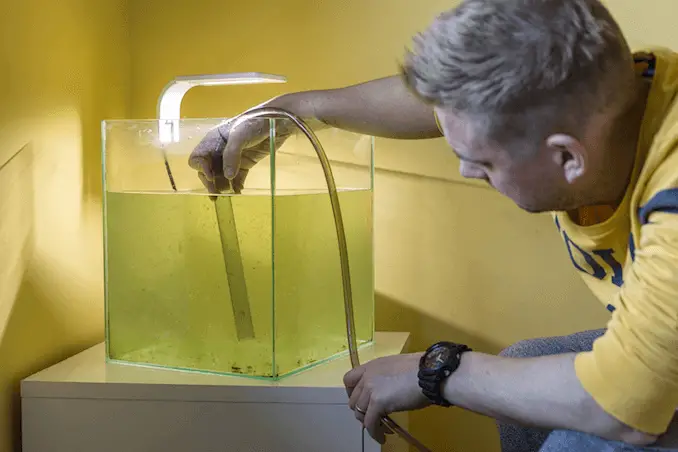
Y'all'll need to supercede roughly 10-xx% of the water in your aquarium every 2-3 weeks.
Use a siphon gravel vacuum, with an fastened hose to clean the gravel and remove the water.
Y'all should suck up small amounts of gravel using the siphon, the waste volition then be sucked through the tube into the bucket along with some of the water, and the gravel will fall dorsum into place.
Use your thumb to cake the end of the tube to ho-hum down the siphoning process, and brand sure none of the gravel makes it into the tube.
Some siphons have a congenital-in regulator to control the flow of water, some also come up with longer hoses and then the water can be taken straight to the sink (if you don't need to continue it to wash other equipment in).
Not only does this step remove the water, but it as well cleans the gravel past removing plenty of the waste that has fallen into the substrate.
Advertisements
Step Iii – Remove Algae
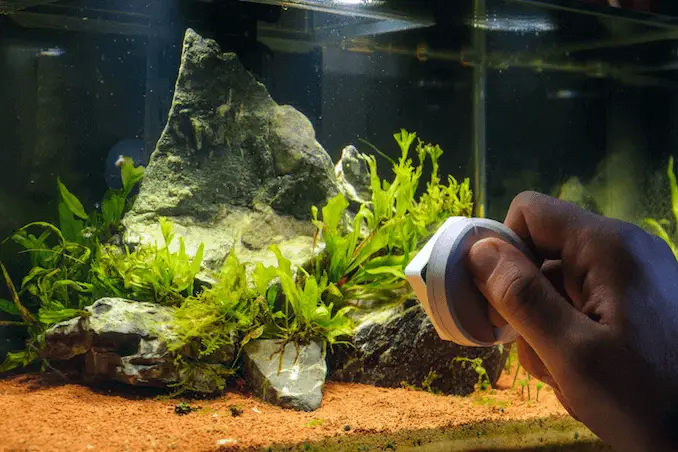
The easiest way to clean the glass in your tank is to utilise a magnetic algae cleaner.
A magnetic algae cleaner consists of two magnets with a soft felt covering. You identify one magnet on the inside of the aquarium, and attach the other to the outside of the aquarium.
You lot then drag the outer magnet effectually the glass of the aquarium, and the inner magnets follow and gently remove the bulk of the algae.
If you have an acrylic aquarium, be certain to choose a cleaner that won't scratch the surface.
If you want to clean any of the other larger decorations you've removed (from step two), you can practise this in the saucepan of siphoned out water; using a clean soft-bristled toothbrush.
Never use lather or other cleaning products; this can be deadly to your fish.
You might too want to consider having a clean-up crew, which will eat some of the algae in the tank.
Footstep Four – Filter Cleaning
Depending on the type and quality of filter that you apply, you will demand to clean and sometimes change the medium in your water filter.
The about common blazon of filter is a sponge filter. To clean this, you should remove it and rinse it out in the saucepan of water that yous have removed from the tank.
Never run your filter under tap water, considering it removes the benign bacteria which is has built upwardly which is necessary for your tank.
Advertisements
Any other filters which act every bit a mechanical filter, as a sponge does (ceramic rings, filter fiber etc) should also exist rinsed and returned equally chop-chop as possible to avoid losing the bacteria colonies.
If your filter contains carbon, ammonia absorbers, or, ion-substitution resins it will demand replacing every couple of weeks because information technology will no longer exist able to absorb materials.
Y'all should also clean the rest of the filter, including the tubing; utilize a filter brush for this.
Step 5 – Water Replacement
Your aquarium now needs to be topped support with h2o.
The type of water you add depends on whether you lot have a saltwater tank or a freshwater tank.
Freshwater Water Training
If you have time to prepare the water in advance, go out the tap h2o out for 24 hours in advance of cleaning your tank to allow the chlorine in the water to evaporate.
Y'all'll demand to use a water conditioner to remove any of the heavy metals, chlorine and toxins which are harmful to fish.
By preparing your water in accelerate, this allows the h2o to reach room temperature too.
Saltwater Water Grooming
Y'all'll need to be more precise with water changes in saltwater tanks. You need to notice 3 parameters – salinity, temperature and pH.
For reef aquariums you'll need RO/DI water (reverse osmosis and/or deionized h2o). You tin buy this from your local fish store, or you tin buy a organisation which produces RO-DI water. Ideally you lot should use this water for whatever type of saltwater tank.
You should only use tap water if your local supply is excellent, and even then, tap water should only be used for fish-just aquariums. If you accept to use tap h2o, have it tested for TDS (total Dissolved Solids) this reading should be zip, but anything less than x is OK.
You'll need to dechlorinate the water and then add together a salt mix. There are lots of different options available, so make sure you cull a quality and reputable make. Follow the instructions according to the product yous choose.
Most salt mixes volition need to be added to warm h2o which is moving. You can do this with a powerhead and a heater.
You lot should go out the water over night before adding it to the aquarium, to let the salt to completely dissolve.
Ever brand certain the temperature and salinity of the h2o is equally similar equally possible before you put in dorsum into the aquarium; this avoids sudden changes in your tank.
Cheque the water parameters in your aquarium after a couple of hours, and also check that the h2o is not cloudy.
Finally, you can clean the exterior of your tank just using an aquarium approved glass cleaned and a textile.
Advertisements
Fish Tank Cleaning FAQs
How do I clean a used fish tank?
The tank should exist completely empty before you clean information technology. You lot'll need salt, vinegar and some soft scrubbing pads.
The vinegar and salt volition remove any hard h2o stains and fishy smells. Make sure you rinse the tank thoroughly before calculation any h2o to information technology.
One time the tank has had a thorough clean, fill up it up with water to check in that location are no leaks. If yous do find leaks, you can utilize aquarium sealant.
How practise I clean a fish tank which has eggs in it?
If the eggs were laid in the gravel, you can go alee with your usual clean but just avert the gravel areas until the eggs accept hatched and the fry are swimming.
If they have been laid anywhere else – just avoid that surface area during your make clean upwardly and don't expose them to air.
Most eggs hatch within a week then they shouldn't really bear on your cleaning schedule.
Should I ever remove my fish?
Unless you take a very pocket-sized tank or bowl, yous practice not demand to remove your fish while you're doing water changes.
Fish do not like being disturbed and removing them can crusade stress. If you admittedly have to, keep them in the same water equally their aquarium.
Ideally, you should practice much more frequent fractional water changes even with a small aquarium or basin.
Summary
Cleaning your aquarium should not be a laborious task, the cardinal to keeping your aquarium clean is regular and ongoing maintenance.
Partial water changes are one of the most of import aspects of ensuring your fish stay healthy and happy.
Making fractional water changes ensures that the leaner colonies, which are essential for your aquarium, are not removed or damaged.
It's non a difficult task; just follow the steps we accept provided!

Source: https://www.fishkeepingworld.com/how-to-clean-a-fish-tank/
Posted by: herringtonslin1977.blogspot.com
0 Response to "How To Clean A Tetra Fish Tank"
Post a Comment